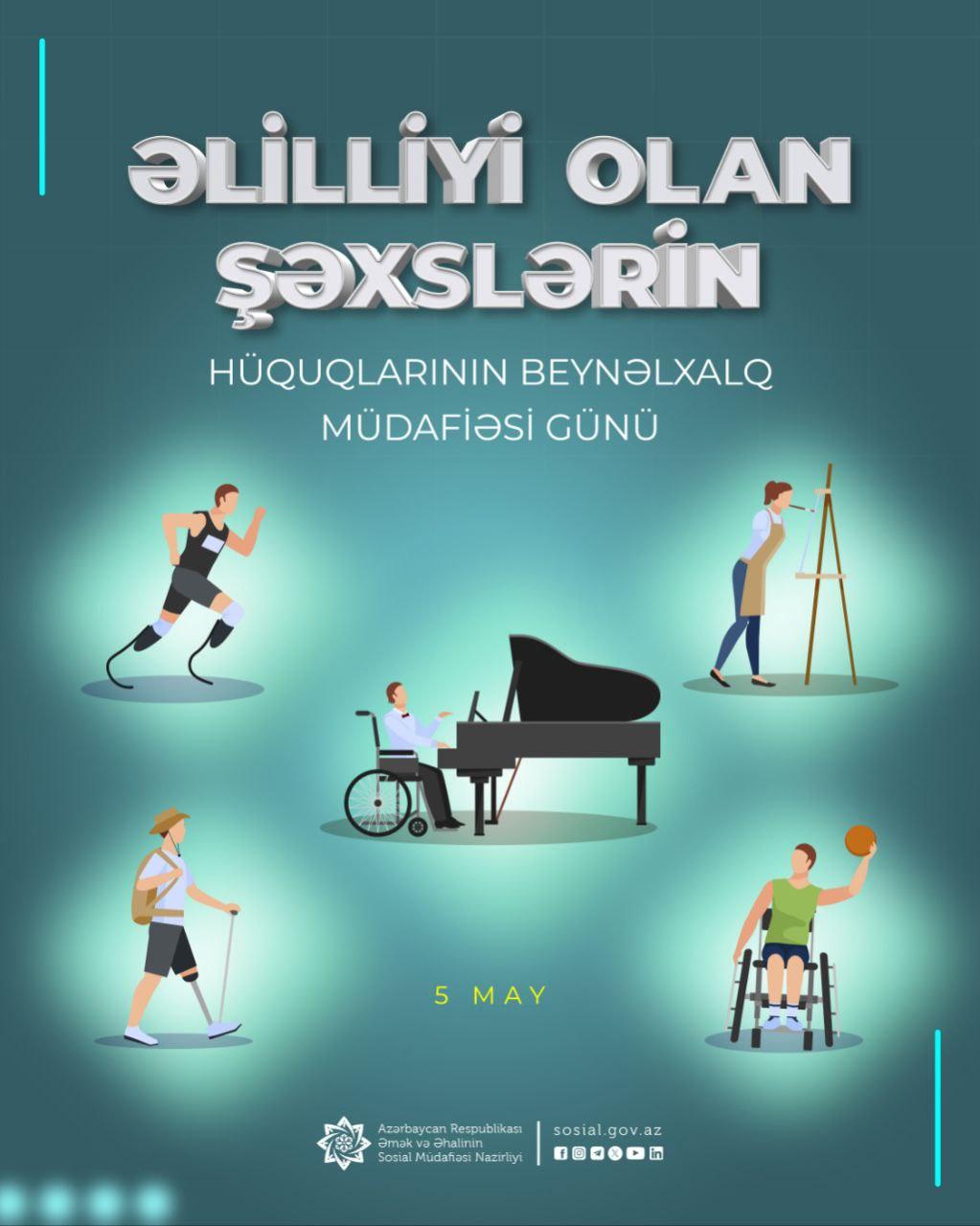
In Azerbaijan, consistent efforts are being made to ensure the social protection, rehabilitation, and integration of persons with disabilities into society.
May 5 is marked annually as the International Day for the Rights of Persons with Disabilities, in accordance with the resolution adopted by the United Nations General Assembly in 1992.
Azerbaijan pursues an active state policy in the areas of social protection, rehabilitation, and social integration of persons with disabilities. President Ilham Aliyev’s special attention and care for vulnerable population groups have significantly strengthened measures in this field over the years.
Through the Ministry of Labour and Social Protection of Population, persons with disabilities are provided with social benefits (pensions, allowances, stipends) based on their disability status. Between 2018 and the present, five social reform packages covering 4 million people have been implemented based on the instructions of the head of our state, with an additional annual budget allocation of 7,6 billion manat. Within this framework, disability-related payments have steadily increased. During this period, the minimum wage rose by 3,1 times, the minimum pension by 2,9 times, the average monthly pension by 2,6 times, and social benefit and stipend payments by 5 times.
The DOST Center for Inclusive Development and Creativity, established on the initiative of First Vice-President Mehriban Aliyeva and opened in October 2021, plays a significant role in fostering the creative potential, talents, and skills of persons with disabilities and other vulnerable groups, and supporting their social integration. More than 700 individuals from these groups have benefited from services provided at the Center and its branches, the first and largest inclusive creative and development space in the South Caucasus. In addition to training sessions, comprehensive rehabilitation activities are also conducted.
Azerbaijan joined the UN Convention on the Rights of Persons with Disabilities in 2006 and has successfully fulfilled its obligations under the Convention, continuously improving national legislation on this basis. As a further concrete manifestation of this commitment, newly adopted legislative acts have introduced additional provisions to the Law on the Rights of Persons with Disabilities aimed at enhancing the social integration opportunities of persons with disabilities. These amendments include new articles on the use of Azerbaijani Sign Language and the provision of access to information for persons with disabilities. The new provisions affirm the state's guarantee of the right to access information for persons with disabilities and officially recognize Azerbaijani Sign Language as a means of communication for individuals with profound hearing impairments during the oral use of the state language of the Republic of Azerbaijan.
One of the major social programs in our country is the housing provision program for the families of martyrs and individuals disabled in the war. Following the 44-day Patriotic War, which ended in victory, this program has been expanded fivefold. In the post-war period alone, 6800 apartments and private houses have been provided to the families of martyrs and war-disabled individuals, bringing the total number to nearly 16000. Additionally, 567 passenger cars were presented to war-disabled persons in the post-war period, with a total of 7700 vehicles distributed to date.
In recent years, the country’s rehabilitation infrastructure has been modernized, and new rehabilitation facilities have been established. The State Medical-Social Expertise and Rehabilitation Agency has significantly expanded its services by introducing new rehabilitation approaches based on the biopsychosocial model and best international practices. Notable progress has also been made in the provision of assistive technologies for persons with disabilities. In collaboration with the World Health Organization, the Ministry has revised legislation to incorporate feedback from persons with disabilities.
As a result of these efforts, the number of individuals receiving rehabilitation services annually has increased from 11900 in 2018 to 123300 in 2024—a 10,4-fold growth. At the same time, the number of types of rehabilitation aids provided to persons with disabilities at the expense of the state budget has increased nearly fourfold — from 34 to 130. During the reporting period, the annual number of rehabilitation aids distributed to persons with disabilities rose 2,7 times, reaching 97000.
A key advancement in this area is the provision of high-tech, next-generation prosthetics to war-disabled individuals. Following the 44-day war, 492 individuals have been fitted with 609 advanced prosthetic devices, enabling them to return to active life and even participate successfully in sports competitions.
Overall, Azerbaijan stands out as one of the countries with an active and increasingly robust state policy in ensuring the social protection, rehabilitation, and full integration of persons with disabilities, as well as the reliable safeguarding of their rights.